

Startup Funding Sources
All startups start with a conception. Ideas do not scale – capital does. Among the most significant problems business starters have to deal with is the awareness of available sources of startup funds and the choice of the means depending on the business stage, industry, and the long-term objectives. By the year 2026, the funding ecosystem will have changed in many ways. Capital is more competitive than ever, founders are more data-driven and investors are smarter.
Regardless of whether you are a first-time founder and are trying to test an idea or a growth stage entrepreneur about to raise more capital, knowing the sources of startup funding can allow you to raise capital in a rational, and not an emotional, manner. This guide will take you through the most significant funding options, their work principles, when they should be used, and ways of not making expensive mistakes.
Learning about Startup Funding Sources
Startup funding sources are the various avenues on which an entrepreneur can raise capital to start, operate, or grow a business. It is possible to generally categorize these sources into equity financing (where you forego ownership), debt financing (where you pay back money with interest), and non-dilutive funding (where you do not give equity back or pay back money).
It is not only about money when choosing one or another but also about power, rate of growth, risk-taking, and the way out.
Bootstrapping: The Secret of a Large Part of Successful Startups
Bootstrapping is among the most formidable startup funding sources, at least in the initial stage. It is the use of personal savings or an early revenue of the business in order to expand the business. A lot of successful founders choose to bootstrap their companies as it enables them to be the sole owner and take independent decisions.
Nevertheless, bootstrapping develops discipline and makes lean operations work, but may reduce growth when the capital requirements are growing fast. It suits well when founders are testing a business model, and they are planning to approach external investors.
Angel Investors: First Strategic Investors
Angel investors are wealthy individuals who also contribute their funds in startups in equity. Organizations such as Angel Capital Association have been able to bring founders into contact with knowledgeable investors in different industries.
Angel investors come in quite handy during the initial stages as they usually offer mentorship and networking services besides the finance. Angels are likely to be more flexible unlike venture capital firms which are slower in their movement. But founders should heavily think on negotiation of valuation and ownership to prevent over dilution.
Venture Capital: Powering up to Rapid Growth
Venture capital is developed in startups that have high scalability and potential growth. These investors like the Sequoia Capital and Andreessen Horowitz invest millions in startup funding sources that have been proven traction and a big market opportunity.
VC funding can take off the business like a rocket but will have high expectations. Investors usually require aggressive growth, quantifiable measures and exit strategy. The venture capital does not suit slow-growth or lifestyle businesses. It is effective with technology based startups that want to grow nationally or internationally.
Bank Loans and SBA-Supported Loans
The conventional debt financing remains as one of the stable sources of start-up funding. Bank loans enable founders to own the whole business and be in a position to get the required capital. The loan programs provided by the U.S. Small Business Administration in the United States lower the risk that entrepreneurs might face and enhance access by lenders.
The biggest benefit of loans is that equity is not forfeited. Repayment requirements, however, lead to financial strain particularly when revenue is irregular. The founders should make sure that the cash flow is predictable before they make the choice of a debt financing.
Government Grants: Non-Dilutive Capital
Government grants are also one of the most appealing sources of start-up funding due to the lack of repayment and stock exchange. Websites such as Grants.gov provide grant opportunities in the federal environment.
Whereas grants are free money, grants are very competitive and in most cases industry specific. Founders have to fulfill high eligibility criteria and fill in elaborate applications. Grants are typically prevalent in the research, innovation, healthcare and climate technology areas.
The Digital Age of Crowdfunding
Crowdfunding has changed the nature of access to capital by startup funding sources. Social media like Kickstarter and Indiegogo enable founders to raise funds directly through the consumers.
This model does not only create capital but it also proves product demand. An effective crowdfunding campaign may demonstrate interest in the market prior to mass production. Nevertheless, it must be heavily marketed, told, and built. Unprepared campaigns are prone to fail in terms of startup funding sources.
Accurate, Real-time Data on the Accelerators and Incubators
Seed funding, mentoring and investor access are offered by accelerator programs such as Y Combinator and Techstars on an equity basis.
These are competitive yet very useful programs. Being accepted to an established accelerator helps to increase credibility substantially and odds of raising follow-on funding. This can also be one of the most strategic startup funding sources available to the early founders.
Alternative Financing Models and Revenue-Based Financing
Revenue based financing is increasing at a very high rate in 2026. The startups do not surrender equity but redeem investors by a set percentage of monthly income. This model is applicable to SaaS companies and companies that have regular income and subscribes.
There are also corporate venture funds like Google Ventures which strategically invest in companies in its industries. This kind of financing will open up partnerships and distribution benefits not in capital alone.
Selection of the appropriate source of startup funding
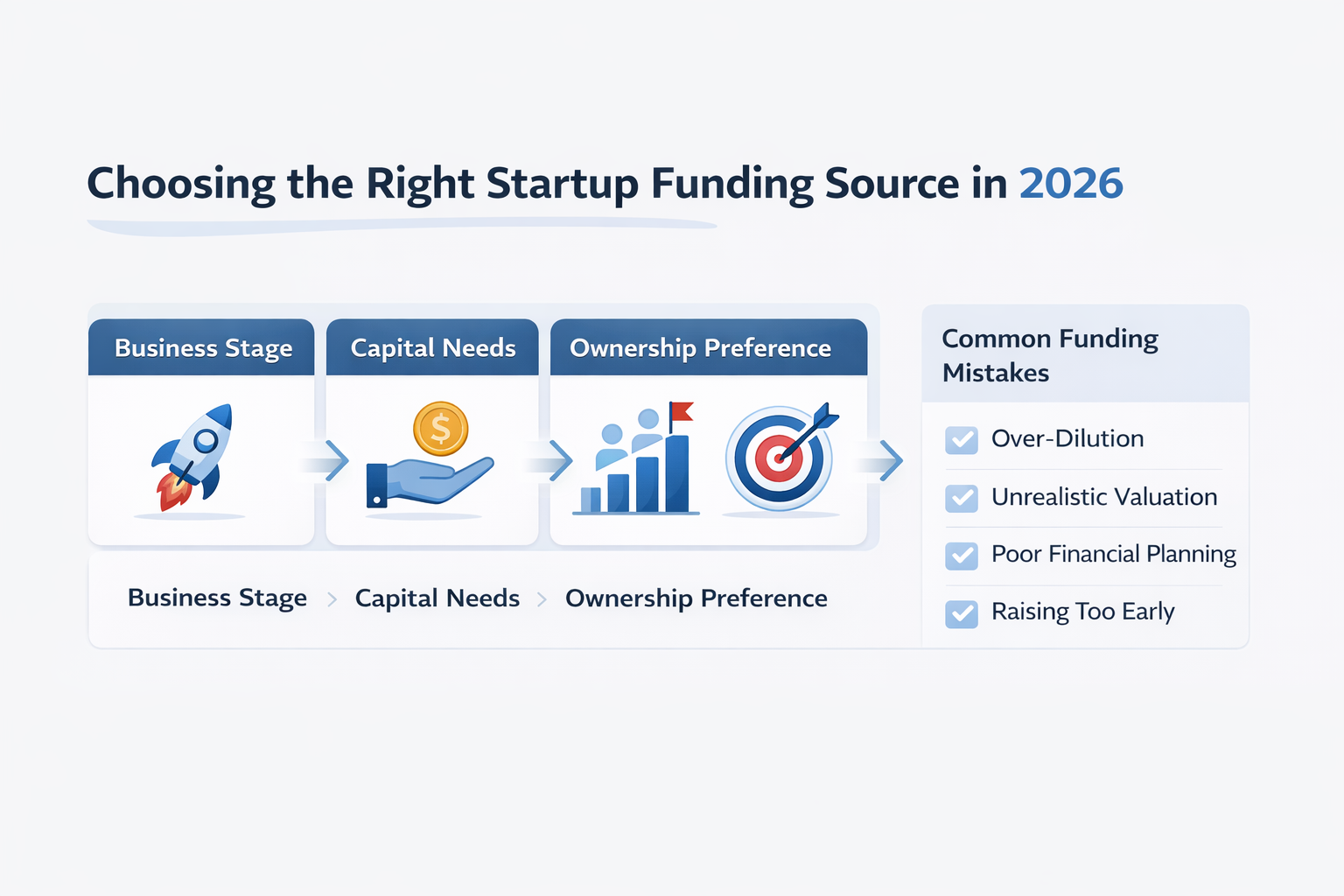
The choice of the suitable source of funds must be planned. Founders should evaluate:
- Business stage (idea, MVP, growth)
- Capital requirement size
- Risk tolerance
- Ownership preferences
- Long-term exit goals
One of such ways is to bootstrap first, then raise angel capital to gain traction, and only seek venture capital once good growth metrics are in place.
Mistakes that Entrepreneurs make
Most founders are only interested in raising funds rather than raising the correct funds. Some of the errors include over-dilution, unrealistic valuation, inadequate financial forecasting, and inadequate due diligence preparation. The other common error is seeking venture capital when the business model is not in need of aggressive expansion.
The investors of 2026 are looking forward to detailed unit economics, clarity of customer acquisition cost, and actual traction data. Emotional pitching without figures is hardly effective.
2026 Funding Trends to Watch
Start up funding environment keeps changing. Startups based on artificial intelligence are getting a lot of investment. Greater attention is getting paid to climate technology and sustainability ventures. Shareholders are also focusing on profitability sooner than they did in the past years. Open measurement and capital usage is more valued at this point than hype-driven growth.
By being aware of these trends, founders can strategize their startups when they are going to the investors.
Conclusion:
Startup funding sources are not just financial instruments; they are what make your business grow in the right direction and be controlled. The most intelligent founders view funding as a tactical move as opposed to a life and death situation. Finding the appropriate capital at the appropriate time, the appropriate source and at the appropriate terms can be helpful to ensure growth is at an accelerated pace without losing sight of the long term goals.
You should perfect your business model, test your market, and get to know your numbers well before seeking to raise some cash. Capital follows clarity.
In case of raising funds in 2026, it is good to begin by determining which source of startup funding fits best based on the stage of your growth and the strategic goals of your business. Misjudgement tomorrow can be avoided by careful planning today.
FAQs:
What are the sources of start up funding?
Various methods in which entrepreneurs raise funds are known as startup funding sources which include bootstrapping, angel investors, venture capital, loans, grants and crowdfunding.
What is the most suitable source of funding?
Angel investors and bootstrapping are usually the best choices to make during the first phase due to the lack of a significant financial commitment.
Is it necessary to give up equity in all sources of start-up funding?
No. Loan and revenue-based financing do not need equity whereas angel and venture capital investment does.
Is VC required by all startups?
No. Venture capital is applicable to high growth start-ups that are scalable and not all business models.
Do companies find government grants hard to get?
Grants are competitive and they demand elaborate application but this does not involve any repayment.