
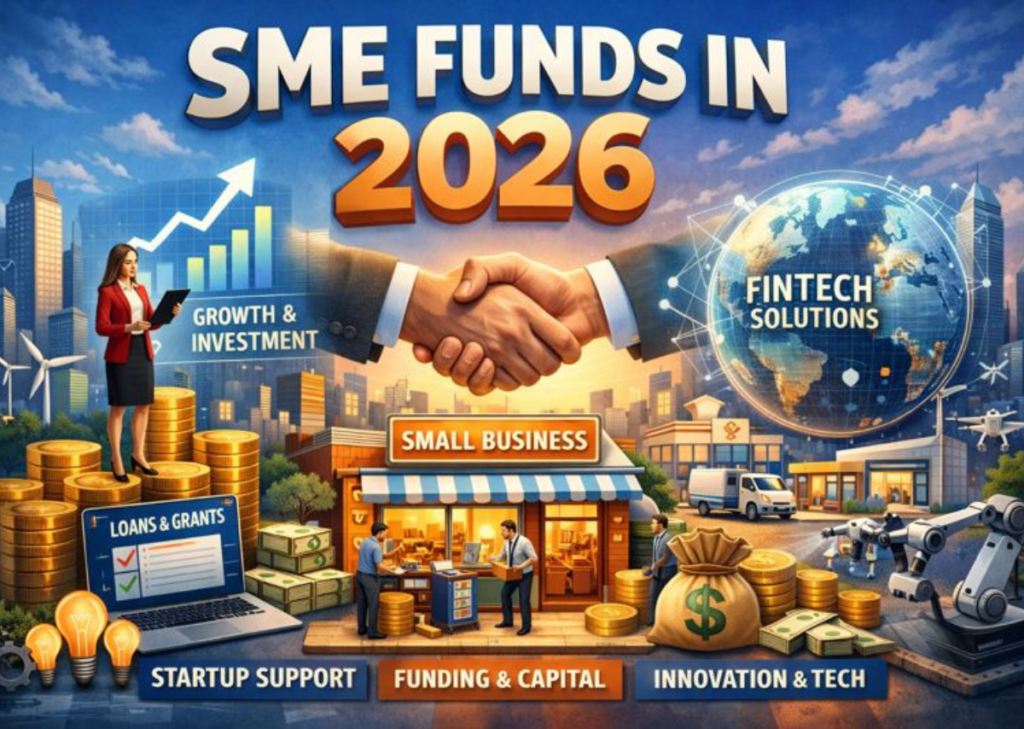
Introduction: SME Funds in 2026
The global economy largely depends on the small and medium enterprises (SMEs) and many individuals have difficulties in accessing funds. By the year 2026, the world of SME financing will be changing as technology makes it more accessible, quick, and simpler to get access to the finances small businesses require.
SMEs have already had access to numerous opportunities with the help of fintech innovations, crowdfunding platforms, as well as AI-driven funding solutions. This is bringing a dynamic atmosphere whereby the older streams of funds are being substituted with newer and more technologically oriented versions.
In case you are a small business owner or an investor, the effect of such technological changes is very important to keep pace in the competition. Delve into the revolution of the development of SME funds in 2026.
What Are SME Funds?
Understanding SME Funds in 2026
SME Funds in 2026 are monies that are specifically allocated to aid small and medium sized enterprises. These sources are in various forms which include loans, grants, equity investments and other financing solutions that are aimed at helping to grow the business.
Evolution of SME Financing
Over the last few years, the process of funding SMEs has changed significantly due to the technological changes. Though the banking is still supreme, other funding options like peer-to-peer (P2P) lending, blockchain-based solutions, and digital lending platforms are on the rise. These are quicker, more open and in many cases more available particularly to the businesses that may not have the required qualifications to take out the traditional bank loans.

The Technology in SME Funding
Technology has a significant role in streamlining the procedure of accessing SME funds. Credit scoring and evaluation of business viability are done by AI and machine learning that make the process of lending simpler and more correct. In the meantime, blockchain technologies offer transparent and secure transactions that minimize the elements of fraud in funding.
How Technology is Reshaping SME Funds in 2026
The Rise of Digital Lending Platforms
Online lending services are the new frontier in the lending industry, where numerous SMEs will turn to in 2026. These websites use big data, AI, and automation to evaluate the credit worthiness of a business and give immediate loan approvals. Such websites as Kiva, Funding Circle, and Lendio provide small businesses with a chance to seek funds with numerous sources, including investors and institutions, without involving the traditional mediators.
Artificial Intelligence and Machine Learning in SME Credit Scoring
Historically, credit scoring has been pegged on restricted criteria and in most cases; newly established SMEs were not approved. Artificial intelligence and machine learning are processed in 2026 which will analyze a huge volume of data and transaction history, social media presence, etc., to generate a more realistic view of the financial health of a company. This model enables on-the-job customization of the funding plans and provides an opportunity to take a loan to businesses with irregular financial backgrounds.
Blockchain-Based Solutions and Crowdfunding
Over the past years, crowdfunding has been a phenomenon and such platforms as Kickstarter and GoFundMe have given SMEs access to a vast pool of investors. The crowdsourcing technology is ensuring that crowdfunding becomes more secure, transparent and efficient through its ability to provide decentralized, smart contract based agreements that ensure that funds are used according to the purpose.
Types of SME Funds Available in 2026
Traditional SME Funding Options
Bank loans, government grants and venture capital are some of the conventional sources of funding. These sources continue to be applicable in the year 2026, though they usually require a lengthy approval procedure, high eligibility requirements, and high-interest rates. There is a rise in the usage of alternative solutions as a more flexible approach to solving problems by SMEs.
Alternative Financing Solutions
- Peer-to-peer Lending (P2P): P2P sites are those that enable the direct access of businesses to the investors by skipping the banks. Here the SMEs will be able to secure easy loan terms and reduced interests.
- Invoice Financing: Organizations are allowing their outstanding invoices to be sold to a third party in order to get direct cash.
- Equity Crowdfunding: Companies gather finances by means of selling shares of equity to a crowd of small investors.
- Revenue-Based Financing: The revenue-based financing provides flexibility in repayment plan as it allows SMEs to repay loans, and the amount they repay is dependant on their revenue.
Benefits of SME Funds in 2026
Accessibility and Convenience
Accessibility is one of the greatest opportunities of SME funds in 2026. Technology simplifies the accessibility of funds by both businesses to online access without the necessity of physical meetings and the complexities of paperwork. Loans or funding can be availed to the SMEs directly through their smartphone or computer, thereby making the process simple and saving time.

Quickened Processing and Reimbursement
The days of taking weeks to get a decision on funding are behind. Digital platforms and AI-assessments enable businesses to be approved of their loans in 24 hours and therefore respond fast when an opportunity presents itself. This is essential where businesses require fast growth or respond to market factors.
Flexibility in Loan Terms
The emergence of alternative financing provides the SMEs with more leeway in repaying. Small businesses have the ability to select financing options that are consistent with their growth patterns and cash flow through invoice financing and revenue based loans.
Challenges of SME Funds in 2026
High Competition for Funds
The number of sources of funding has increased but the competition on the availability of funding is also high. As more businesses compete against each other in terms of limited resources, SMEs should be keen to make sure that they possess good business model and a good online presence to create a distinction among others.
Threat of becoming too dependent on Technology
Technology is an effective instrument that is dangerous. The SMEs should have in place measures of ensuring that they are updated on the safety of the online sites as well as not over-trusting the AI-powered judgments that might not consider all the human elements in the business performance.
Conclusion:
A radical transformation of SME funds in 2026 is to be undertaken, which is mostly influenced by technology. With AI-driven credit rating, crowdfunding, and blockchain, there is an increased chance of businesses getting the capital they require in order to achieve success. Through the appropriate solutions, which are technology-based, the SME Funds in 2026 are able to obtain funding which is quicker, more adaptable, and which is in many cases, cheaper. Use these sophisticated tools to gain the advantage over the competition and embrace the future of SME financing.
FAQs
How can AI be used in funding SMEs?
With the aid of AI, creditworthiness is evaluated on the basis of a greater variety of data points, which provides more precise and personal funding opportunities to SMEs.
What will the future of crowdfunding platforms be in 2026 when using SMEs?
Crowdfunding sites enable SMEs to attract funds on a significant base of individual investors, and in many cases, a reward is provided or equity is given in exchange.
Are online lending systems secure to SMEs?
Indeed, a lot of online lending tools implement encryption, blockchain, and secure payment services to safeguard business and investors.
What are the dangers of alternative SME financing?
Although alternative financing may offer expedited access to funds, the conditions may also be unfavorable, and there is a high competition to get the funds so it is more difficult to get funding through alternative financing.
Which is the best SME funding option to choose?
Take into account the needs, cash flow and stage of growth of your business. Quick funding would be better through alternative financing, whereas traditional loans would be appropriate in long-term investments.