

Introduction:
Do you have a startup that is getting capital to make your business grow and wary of relinquishing equity? This may be the best solution to non-dilutive funding. This kind of capital enables you to attract capital without relinquishing your ownership of the business. Being a tech innovator or a small business owner, learning about non-dilutive financing can be the key to success.
This article will discuss the concept of non-dilutive financing in details with its advantages, nature, and its comparison to conventional means of financing. At the end, you will be well placed to know how to use this effective financial tool to your business.
What Is Non-Dilutive Funding?
Non-dilutive funds are the funds raised by a company that do not require any ownership or equity. Non-dilutive funding does not require you to sell part of your company as traditional sources of investment like venture capital or angel investment.
This is an attractive alternative to entrepreneurs and startups. It makes sure that you remain in charge of your business decision making and vision. The non-dilutive type of funds can be in different forms such as grants and revenue based funding among others having different benefits depending on the business requirement.
Key Benefits of Non-Dilutive Funding
1. Retain ownership: You have the full 100 per cent ownership of your business.
2. No Repayment Pressure: A lot of non-dilutive sources of funds such as grants are not repayable.
3. The funds are flexible in their usage; the funds can be utilized in product development, marketing, and hiring.
Types of Non-Dilutive Funding
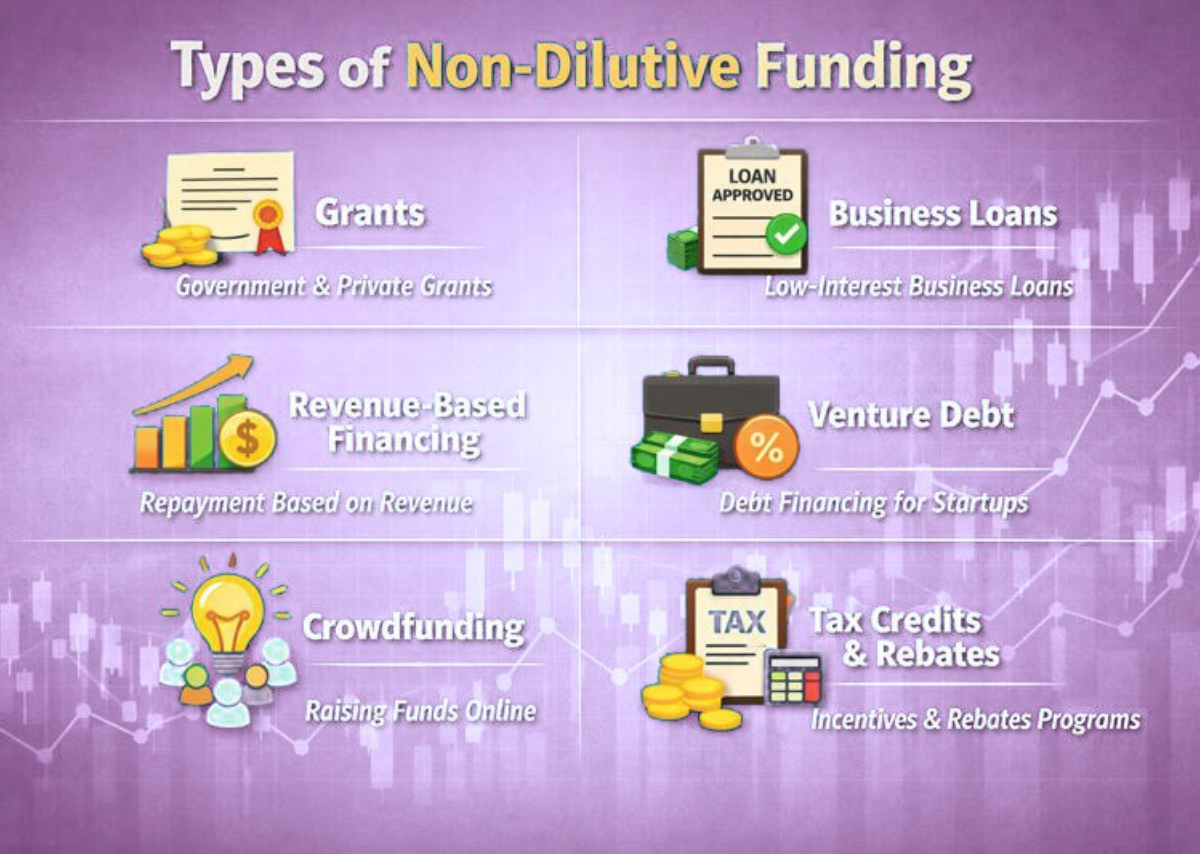
Non-dilutive sources of funds are of various types and have their own requirements and benefits. These are the most popular options that startups and entrepreneurs have.
1. Grants
Grants are introduce awards provided by the government, nonprofit, and corporations that do not need to be paid back. They can be provided to businesses operating in a certain industry or enterprise, e.g. technological advancement or communal services.
How It Works:
• Won usually through an elaborate application procedure.
• Specialised in certain industries or projects.
• No collateral is secured, and no wages have to be paid back.
Pros:
• No repayment obligation.
• No equity dilution.
• Suitable to businesses that are heavy in R&D.
Cons:
• Highly competitive.
• Needs to satisfy high standards.
2. Revenue-Based Financing
Revenue-based financing enables business owners to access funds using their sources of revenue. As an alternative to dilution of the equity, business will repay the loan using a percentage of the yearly or quarterly income until the loan is paid off.
How It Works:
- Funding is also provided in advance on business revenue basis.
- Repayment is in form of a constant percentage of revenue.
- When a relationship is entered into, it is over when the agreed amount is repaid.
Pros:
- No equity dilution.
- Repayment terms that are flexible in regards to your business performance.
Cons:
- Repayment amount may vary depending on revenue.
- May are associated with increased aggregate payments in contrast to conventional loans.
3. Crowdfunding
Crowdfunded sites enable companies to attract many small investors who frequently in exchange get pre-orders or a reward. Crowdfunded business does not require the business to relinquish equity as in the traditional way of investment.
How It Works:
• The entrepreneurs submit their business idea to a crowdfunding platform.
• Sponsors contribute to money, then get rewards or they get early access to products.
Pros:
• No repayment or equity loss.
• Going to be a good market test.
Cons:
• Time-consuming to organize.
• The doubt about raising the amount of the entire target.
4. Government Loans and Programs
Startups are funded through government loans at low-interest rates such as those made by the Small Business Administration (SBA) in the U.S. Though, this does not necessarily cover funding, those loans have friendly terms as opposed to the usual bank loans.
How It Works:
• Business performance and need based low interest loans.
• Frequently demand collateral but not a demand to part with equity.
Pros:
• Low-interest rates.
• Extended repayment terms.
Cons:
• Must have an excellent credit score and a proper repayment schedule.
• Collateral requirements which may be present.
How Non-Dilutive Funding Compares to Traditional Funding
In the case of financing a business most entrepreneurs are presented with a decision to choose between dilutive or non-dilutive. Here’s a comparison of the two:
Equity Financing (Dilutive Funding).
Equity financing is a scenario where you sell out a portion of your business to investors in exchange of capital. This may involve venture capital, angel investment or even crowdfunding in equity.
Pros:
• Capital can be raised within a short period of time.
• Investors can offer good advice and networking.
Cons:
- You give up a part of the ownership of your company.
- The risk of conflict in the direction of business.
Non-Dilutive Funding
Conversely, non-dilutive raises will enable you to maintain complete ownership and at the same time access the funds necessary to expand your business. This is particularly helpful to those businesses that do not wish to relinquish control.
Pros:
• Stay in complete ownership and control.
• There is no repayment pressure in case the funding is conducted in the form of grants.
Cons:
• May Have complicated application procedures.
• The amount of funds that can be funded is less than in equity financing.
Is Non-Dilutive Funding Right for Your Business?

This is because there are a number of factors that determine whether to use non-diluteive financing and the most suitable option in your business:
• Business Stage: Non-dilutive financing is the best fit when an early-stage business needs to expand without dilution of ownership. Revenue-based financing may be useful in case your business is already earning a consistent income.
• Funding Requirements: Grants or crowdfunding could be the best fit in case you are in need of a small capital to run a certain project. In the case of bigger and continuing requirements, consider either revenue financing or government loans.
• Growth Plan: Non-dilutive funding is a more sustainable one in case you are aiming to grow in the long term without losing control.
Conclusion:
Non-dilutive financing is a lifeline to entrepreneurs and startups who seek to expand without losing control and ownership. Non-dilutive funding can provide the flexibility and financial assistance that most businesses require to succeed, whether it is in the form of grants, revenue-based financing or a government loan.
It is always advisable to research on the most suitable type of non-dilutive funding before applying to any of these funding sources depending on the level of development of your business. By doing the right thing, you can tap into capital and maintain your vision as well as achieve long term success.
FAQs
1. What does it mean by dilutive and non-dilutive funding?
Dilutive financing involves businesses relinquishing ownership in exchange of capital whereas non-dilutive financing does not involve the exchange of equity as the business owners keep all the control.
2. Is it possible to use non-dilutive funding on every kind of business?
Yes, non-dilutive funding is accessible to a broad list of industries, although the eligibility and funds might depend on the type of business and stage.
3. Is it hard to get grants to startups?
Now grants are very competitive, and there is a lot of openness to eligibility. They do not offer repayment though they are a great advantage as the funds are made available without any repayment.
4. What is revenue-based financing?
Revenue-based financing enables the business to get the finances of a business on the basis of its revenue and repayment is in terms of a certain percentage of the monthly or quarterly revenue.
5. What are the benefits of non-dilutive funding to venture capital?
Non-dilutive financing enables the business owners to maintain the full control and ownership without being under repayment timelines as compared to venture capital which is usually characterized by equity and 2-democracy of control.