
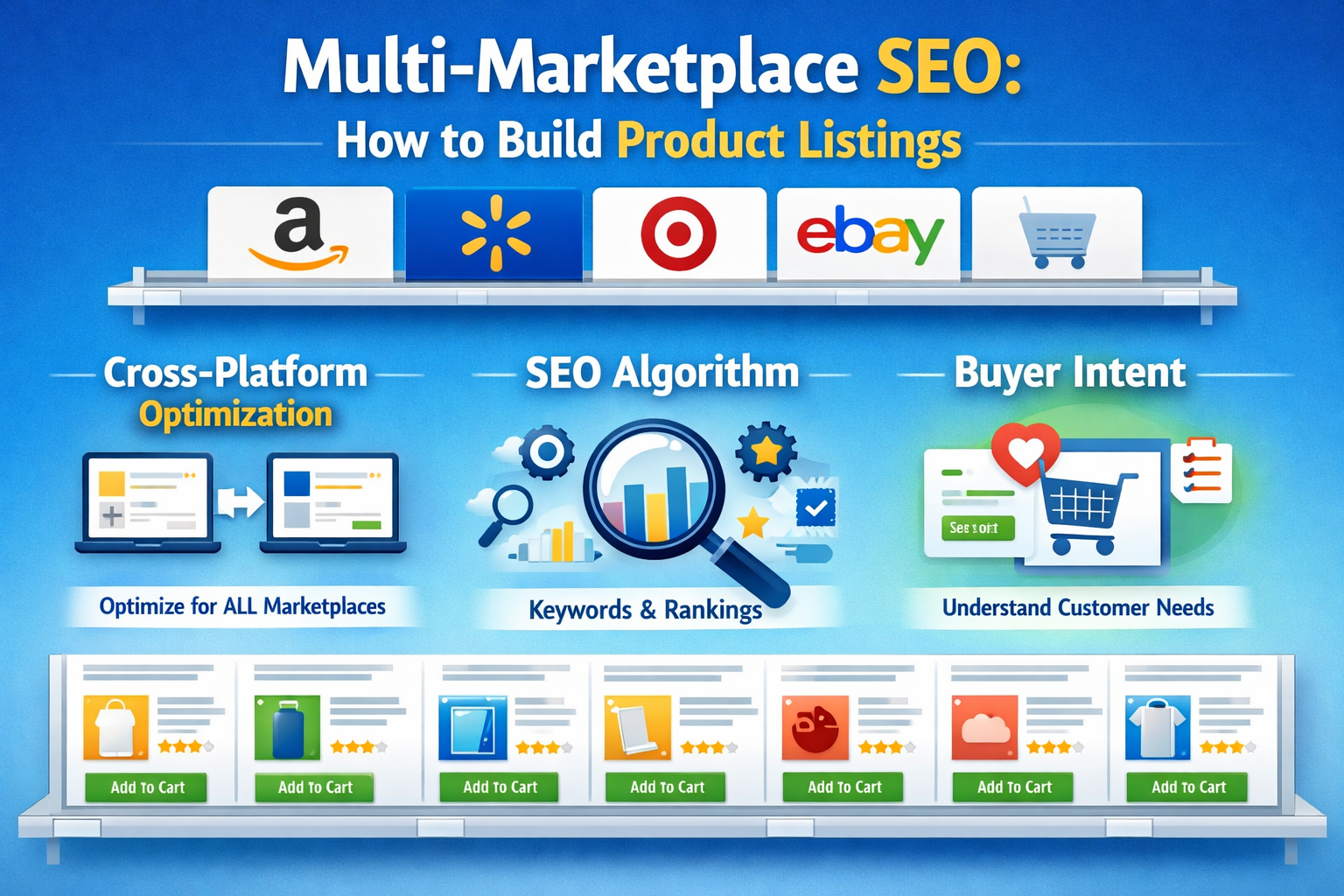
How to Rank on any Marketplace Shelf
It is challenging to sell on a single marketplace. If you are selling four or five at a time that is another dimension. All digital shelves, Amazon, Walmart, Target, and others, have their own rules, order of placement, and compliance requirements. Nevertheless, your brand must have regular exposure.
There can no longer be such a thing as multi-marketplace SEO that is optional. The consumer flows between Google and AI assistants and marketplaces before choosing in 2025. Your listings need to be optimized, not only on a single algorithm, but on a whole ecosystem.
Marketplace SEO: Algorithms to Intent: The Discoverability Is Transforming
Search behavior has changed. Customers do not necessarily begin within a market anymore. They ask questions on Google. They use voice assistants. Before even opening an app, they refer to AI.
That is that your product listing is no long simply a product page. It is an asset of discoverability. It has to respond to queries, correlate purpose, and make organized information that the algorithm can comprehend with ease.
In contemporary market place search, three factors are linked:
- Algorithm requirements
- Buyer intent
- Cross-platform visibility
When you barely make it in one of these, then your discoverability is impaired.
The future of search marketing in 2025
The understanding of marketplace SEO was to optimize to Amazon. That is no longer enough. The future of the path to purchase is disjointed in 2025. A shopper might:
- Search on Google
- Request an artificial assistant to make suggestions.
- Compare prices on Walmart
- Check clearing at Target.
- Finally purchase on Amazon
All touchpoints affect the final decision.
Search engines are now able to display marketplace listing on results. The AI assistants condense the information on products and present them. And unless your listing is organized, clearly filled, and has goal-oriented copy in it, it may never show in such recommendations.
On your product detail page(s), it should work on:
- Search of internal marketplace.
- External search engines
- Conversational AI systems
SEO in the market place is currently a matter of flexibility rather than position in the ranking.
The Death of Organic Search is Not the End, It is the Beginning
It is logical that when a person puts the query of the best vitamin C serum in sensitive skin he/she tends to enter Google and not Amazon. Amazon products are being shown in search results increasingly. However, it is only optimized listings that are indexed accordingly.
To optimize your PDP (product detail page) to the outside world:
- Clear keyword structure
- Bloodless headings and bullets.
- Clean URL structures
- Structured product data
The listing is to be treated as a landing page. No longer a catalog entry within the company.
Long-tail high-intent keywords are brands that are capturing traffic before a shopper even goes to a marketplace.
AI Shopping Assistants become the New Intermediary
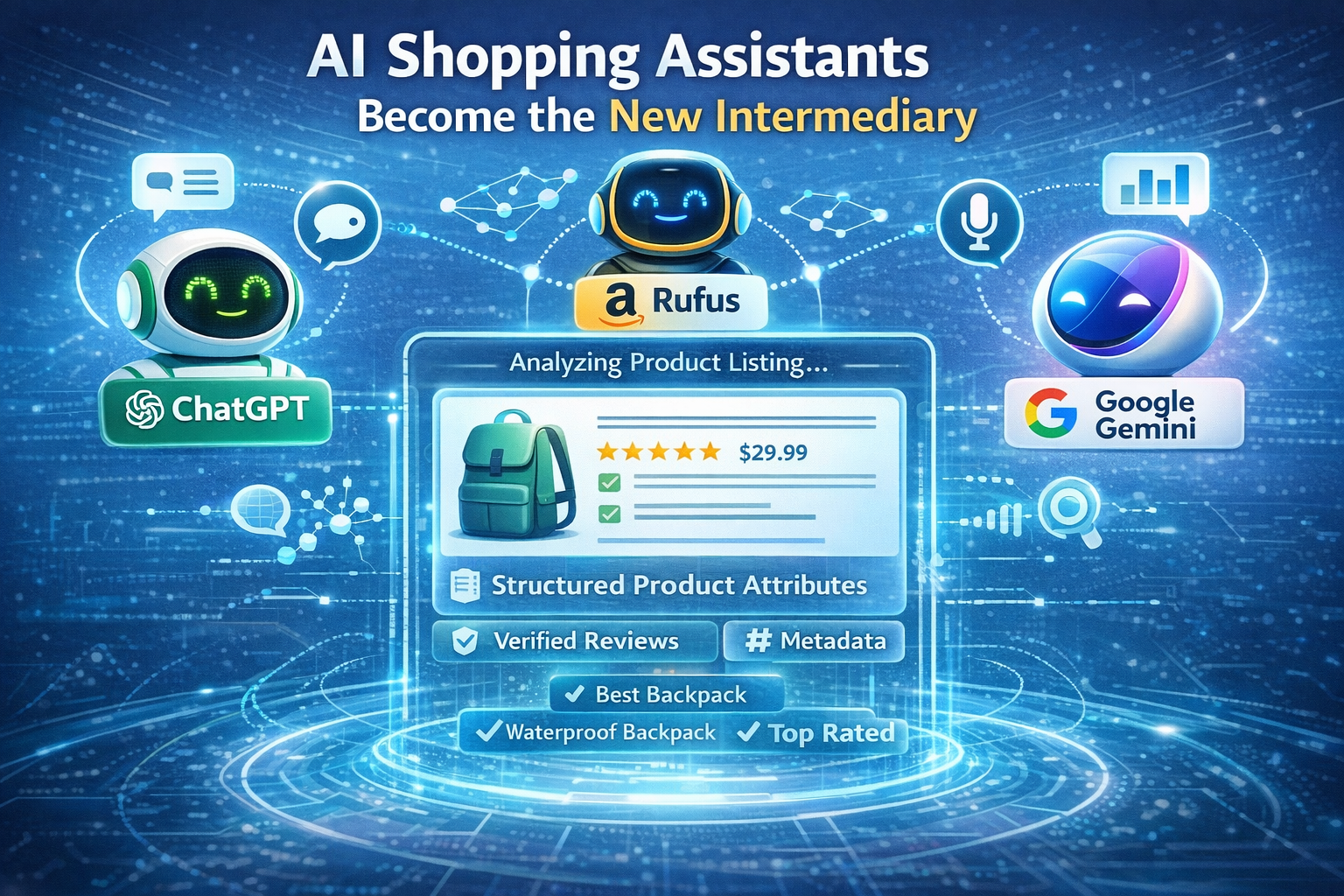
Customers do not enter short keywords anymore. They ask full questions:
What are the best noise-cancelling headphones which are less than $150 and fast delivery?
The applications of AI assistants like Amazon Rufus and Google Gemini read summarized data, reviews and contextual descriptions in order to produce suggestions.
These systems rely on:
- Systematic product characteristics.
- Clear use-case descriptions
- Verified reviews
- Clean metadata
They are not merely dependent on key-word crammed. They get completeness and transparency.
Your listing should be good or well-organized, otherwise, it will not be included in AI-generated summaries.
The Strategic Visibility Implies the Playing at All Levels
Increasing to the first position on Amazon is no longer the final objective. Strategic visibility means:
- Being indexable on Google
- Providing the AI systems with correct product data.
- Placing in each of the markets.
- Enabling mobile-first experiences.
When search engine optimization ends at the marketplace search engine, you have half of the funnel.
Scattered Processes, Coherent Strategy
Every marketplace is concerned with various signals.
- Amazon pays much attention to conversion rate.
- Walmart measures systematic qualities and trustworthiness of the seller.
- Target focuses on sanitary taxonomy and speed of fulfillment.
It is not possible to duplicate the same material everywhere. Re-writings are inefficient in rewriting each listing individually.
Brands that are smart have modular frames:
block 1 description of core product features
|human|>block 2 description of core product features.
- Layers of platform keyword.
- Competent attribute mapping.
- Compliance-adjusted formatting
This is a strategy that balances between efficiency and customization.
The Risk of duplicate Listings by copy Pasting
It appears to be effective to duplicate your Amazon listing on Walmart. It is not.
Here’s why:
- Walmart punishes irrelevant characteristics.
- Promotional language in the Amazon fashion can not pass the Walmart editorial test.
- Repeated information in the market places may disorient the Google indexing.
SEO by copy-pasting compromises the performance in favor of speed. The platforms need specific alignment.
Marketplace SEO Basics
Learn the basics first then scale.
What Remains the same between Platforms
There are SEO truths, which are universal.
- Relevance of Keywords Reigns Supreme.
- Availability of Products has an influence on Visibility.
- Trust is a Driving Force of Performance by the Seller.
- Metrics of CTR and conversion are not irrelevant.
Factor of Ranking that depends on the platform
Amazon SEO Strategy
The algorithm of Amazon is conversion-based. Listings should depict purchase readiness.
Best practices include:
- Powerful keywords in the title.
- Bullet points that are motivated by benefits.
- Objection-handling content
- Well defined compatibility information.
Walmart Listing Optimization
The ranking system of Walmart appreciates systematic clarity.
Focus on:
- Complete attribute fields
- Proper product descriptions.
- Price competitiveness
Listings at Scale optimization
The structure is necessary to scale SEO to hundreds or thousands of SKUs.
Identify Content Gaps and Group by Intent: This step serves to identify the gaps in contents and group them in accordance to the intended purpose.
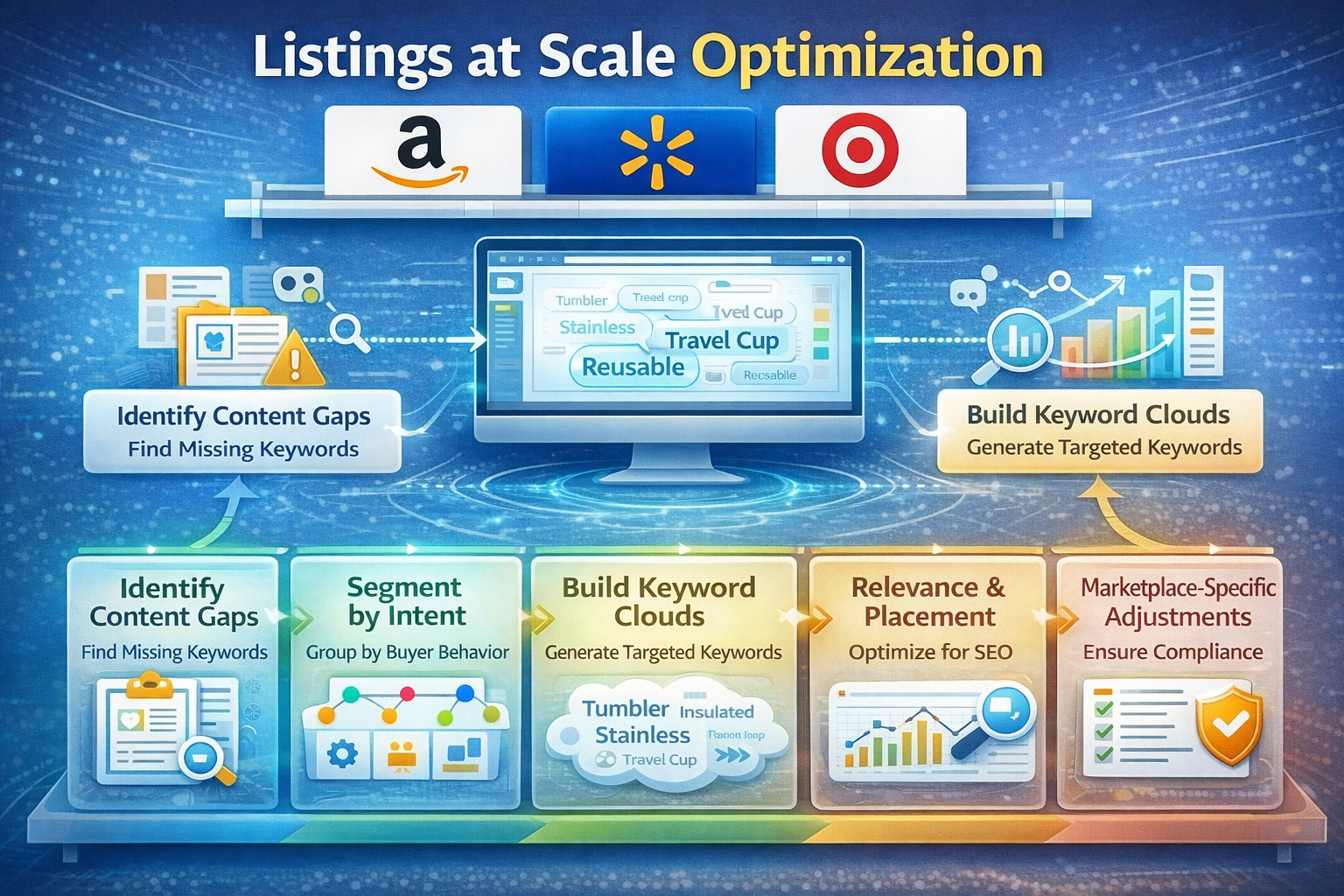
Examine the poor performing listings. Rather than auditing product by product, cluster products by the similar cases of use.
Keywords targeting is enhanced by intent-based grouping.
Step 1: Frame Segments and Use Cases Priorities.
- Not all segments of customers have the same value. Focus on:
- Search queries with high converting rates.
- Low-competition opportunities
- Strong margin product clusters.
- Efficiency is motivated by priority.
Step 3: Build Keyword Clouds
Create layers of keywords (structured):
- Primary high-volume terms
- Phases describing in long tails.
- Attribute-driven modifiers
Stuffing them into a single field is not advisable. Distribute strategically.
Step 4: Relevance and Place More than Volume
- Location is better than the quantity.
- Titles require clarity
- Features should be converted into benefits by bullets.
- The context elaborates descriptions.
- There is no compromise on compliance.
Step 5: Marketplace Rule by Rule
- Amazon desires conversion oriented copy.
- Walmart focuses on attributes that are structured.
- Taxonomy alignment and clean formatting are the favorite of Target.
There are modular frameworks, which can be adapted and not duplicated.
Product Listing Optimization with AI
The SEO of the marketplace is being changed by AI.
Modern platforms analyze:
- Underperforming SKUs
- Competitor content gaps
- Keyword trend shifts
- Conversion bottlenecks
AI tools propose the best variations and give priority to tasks depending on what they could do.
It does not involve the replacement of teams. It is about scaling smarter. AI determines patterns that human beings might not notice and speeds up the testing process.
AI is not only able to produce text. It directs strategic decisions.
Tools for Marketplace SEO
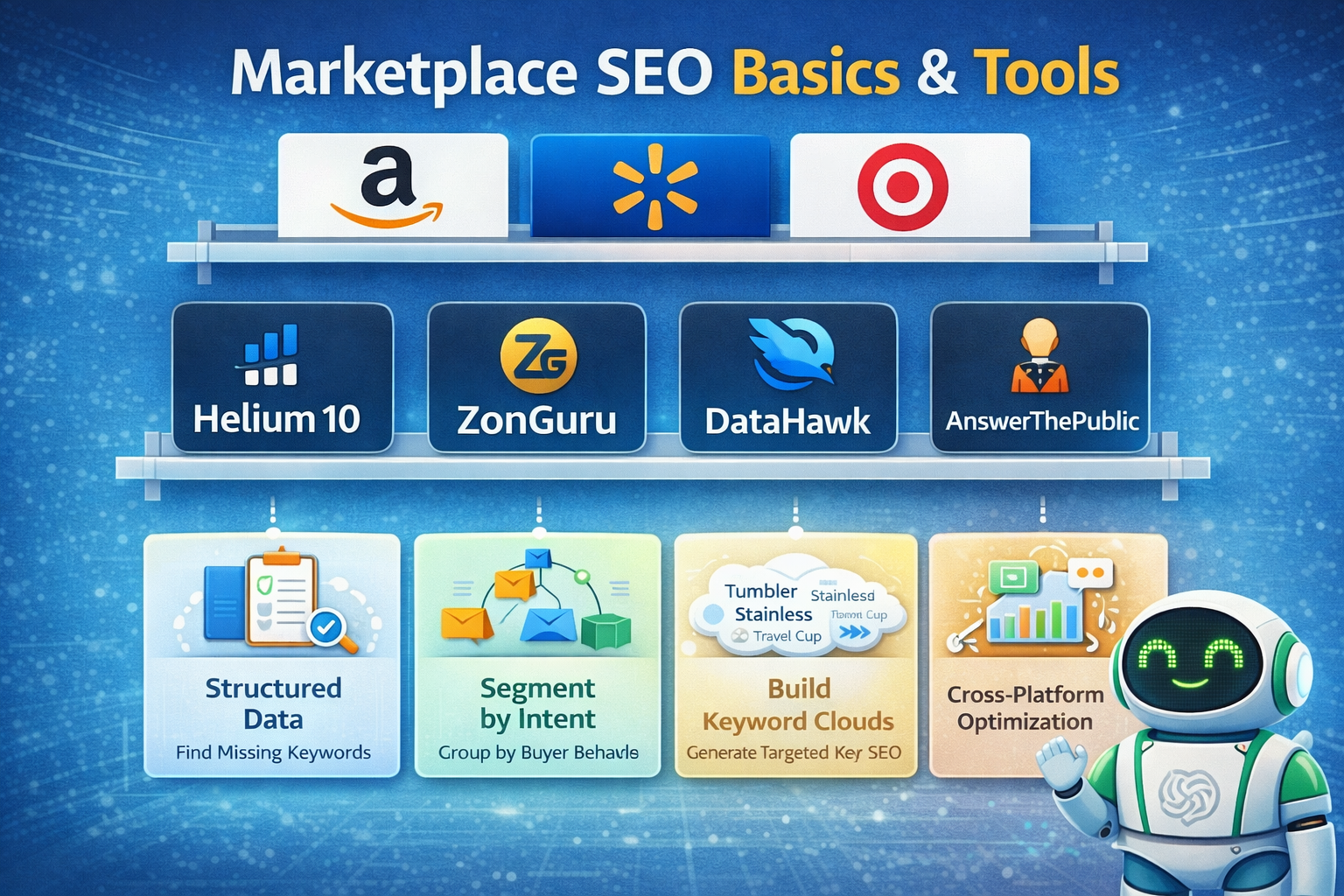
Brands that perform highly are based on data-driven platforms.
- Helium 10 to use as a keyword intelligence.
- ZonGuru to insight into listing.
- visibility tracking DataHawk.
- Discovery on long-tail AnswerThePublic.
The tools promote decision making. Success is still decided by strategy.
Conclusion
There is no checklist to multi-marketplace SEO in 2025.
Brands that are successful are concerned with three levels:
- Platform fundamentals
- Cross-marketplace adaptability
- Intent-driven optimization
AI enhances execution. Systematic models facilitate magnitude. Content that interests the buyer converts.
The online shelf is competitive. However, products that merge structured information, marketplace adherence, and purpose alignment will take over the spotlight over Amazon, Walmart, Target, and others.
Ranking is no longer the main objective of marketplace SEO. It is of being found in all the places your customer sets out.
FAQs
What do we mean by multi-marketplace SEO?
The practice of optimizing the products to rank in the different platforms such as Amazon, Walmart, and Target whilst adjusting to the ranking variables of the various platforms is known as multi-marketplace SEO.
Is it possible to use the same listing on all the marketplaces?
No, all marketplaces have various algorithms and compliance regulations, and listings need to be customized and not copied.
What is the effect of AI on marketplaces ranking?
Artificial intelligence helps to process structured information, reviews, and relevant indicators, thus structured and purposeful rankings work better.
What are the highest ranking factors?
Visibility is highly influenced by the relevance of the key words, the conversion rate, price competitiveness, availability, and the customer reviews.
Do marketplace SEOs matter regarding external traffic?
Yes, search engines such as Google can increase engagement metrics and enhance the ranking power.