
Jira Requirements Traceability Matrix Explained To Teams
The contemporary software and product teams exist in the environment of unceasing change, changing needs, and augmenting pressure of compliance. In such an environment, it takes a short time to lose sight on the reasons why something has been built, who ordered it and whether it has been well tested can easily derail the delivery. And it is at this point when a Jira requirements traceability matrix would be critical, which views the business needs and development work as the formal connections between business needs and validation.
And Jira Requirements Traceability Matrix is not simply a piece of documentation anymore. When deployed within Jira, it makes it a living system that links requirements with user stories, tasks, bugs, test cases, and releases. The article presents the concept in depth and demonstrates how requirements traceability matrix in Jira functions and provides teams with approaches, tools, capabilities, advantages, and a practical use based on an informational and expert view.
Traceability Matrix Basics Understanding Requirements Traceability Matrix Basics
A requirements traceability matrix can also be abbreviated as RTM, is a formal approach to mapping and tracking requirements through the project lifecycle. It makes sure that all the requirements are considered, exercised, tried and come with no loopholes. Traditionally RTMs were spreadsheet based but this soon became outdated and prone to errors.
In essence, a Jira requirements traceability matrix provides answers to three important questions. What had been requested, where had it been applied, and how had it been substantiated. By having these answers directly linked within Jira, there is the assurance among the teams that nothing falls through the cracks.
Why Jira Is Ideal Platform
Jira is popularly employed in issue tracking, agile project management and workflow automation. This is due to its flexibility; it is a natural platform of constructing a requirements traceability matrix without re-inventing existing processes. Depending on the way a team organises their projects, requirements may exist as epics, stories, or special types of requirement issues.
The strong issue linking system is one of the reasons why Jira is effective. Such relationships as to be related to, to block, to be tested or to implement are possible within teams and are the basis of traceability. These links enable any person to move down the chain of high level requirement to the specific test case or defect of a particular requirement.
Core Components Of Jira RTM
There are a few components that interact with each other within the platform to create a Jira requirements traceability matrix. The requirement is the first component. This may be an epic, custom type of issues, or a story, based on the formalness of the process of requirement in the organization.
The second aspect is the work of implementation. This has user stories, tasks and subtasks that directly satisfy the requirement. When these issues are connected to the initial requirement, the teams have a sense of direction in implementation.
The last element is reporting. Jira traceability filter, dashboards, and plugins assist to visualize traceability by all stages. The combination of these elements creates a scalable Jira Requirements Traceability Matrix.
Key Benefits For Agile Teams
Traceability to agile teams can be a burdensome term associated with waterfall. Nevertheless, it does not make agility slower when applied properly in Jira, on the contrary. Among these advantages is better visibility between sprints. Product owners are able to instantly see the progress, completed and blocked requirements.
The other advantage is less rework. This is because by ensuring that requirements are clearly connected to implementation and testing, the teams would detect the misalignment in the early stages. This will reduce late stage surprises and scope creep which usually causes pain in agile environments.
Traceability enables enhanced collaboration also. Jira has developers, testers and stakeholders working off the same source of truth. The mutual exposure helps to develop trust and accelerate decision-making without creating several layers of bureaucracy.
Advantages of Compliance And Audit
Several industries, such as finance, health and government, demand stringent documentation and traceability. A Jira requirements traceability matrix will give automatic audit preparedness. All the modifications, remarks and links are stored with time and user data.
Teams during audits would be able to show how every requirement was exercised and verified speedily. This makes it avoid the chaos of last-minute scramble of spreadsheets, emails, and documents. Traceability is transparent and consistent giving confidence to the auditors.
These compliance features enhance internal governance, even in the non-regulated teams. They assist the leadership to be aware of the risk, dependencies and confidence of the delivery without micromanaging teams.
Traceability Under Jira
Jira Requirements Traceability Matrix applies to issue relationships organized in a system and not in a one-time table. The requirements are expressed as problems which are interconnected to the development and testing problems. These connections form a network which works as a matrix in the background.
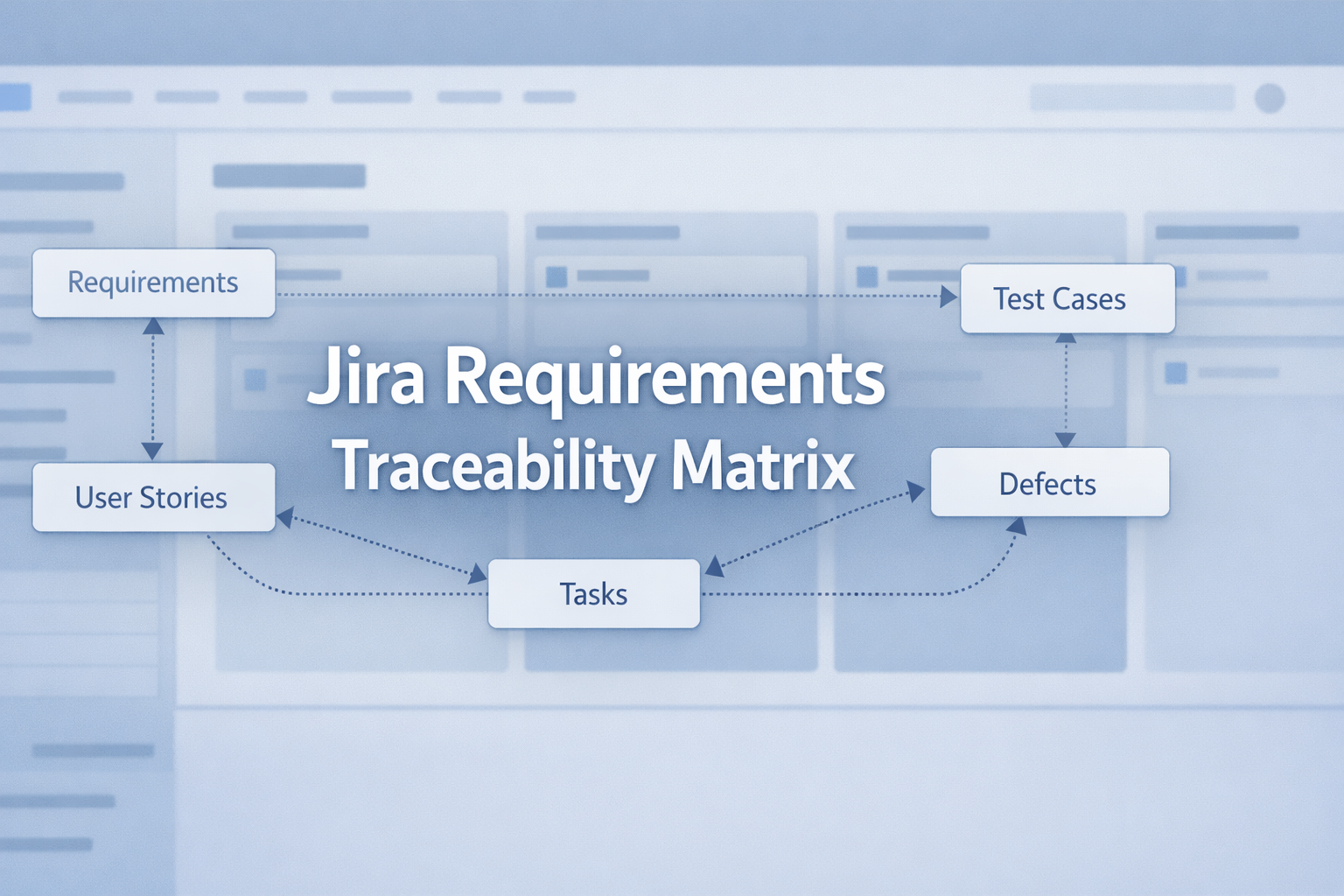
A business requirement may be given an example where it is associated with a number of user stories. Both the user stories tie to tasks and subtasks and the test cases tie to the stories that they are validating. The defects found during testing are also connected, and the loop is closed.
This solution maintains the flexibility and scalability of traceability. Teams do not have a separate document to maintain, instead they use the built-in features of Jira to keep the relationships in the system.
Methods To Build RTM
Developing a requirements traceability matrix in Jira can take place in a variety of ways and the appropriate one will vary depending on team maturity and project complexity. One of the practices is the utilization of epics as requirements. Epics are high level needs, stories and tasks implementation.
The other technique is that of custom issue types that are specifically tailored towards requirements. This is a more formal method that is frequently applied to enterprise or regulated settings. It enables teams to establish requirement-specific fields like priority, source and acceptance criteria.
Other teams have Jira plugins which create automated traceability views. These tools will save manual work and present a visual matrix, coverage report and gap analysis. All of these approaches have their time and Jira does not impose a single workflow.
Using Jira Issue Linking
Any requirements traceability matrix in jira is based upon issue linking. Jira enables the teams to create their own link type that represents the relationships in the real world. To take an example, one story is required to be implemented by another story, and another story is a test case to verify that story.
The use of linking conventions is important. Once the teams have agreed on the types of links and their utility, traceability becomes dependable and significant. The matrix becomes unable to make sense without consistency.
These links form an elaborate map of the project overtime. The new team members are able to grasp the context within a very short time and the stakeholders are able to trace the decisions without having to go through a long process of explaining.
Reporting and Visualization Options Reporting Areas
Traceability should also be visualized and understood to be useful. Jira provides a number of reporting opportunities that can address this requirement. Filter and JQL queries enable the teams to list requirements and issues associated with them in organized views.
Dashboards are a combination of gadgets that display requirement status, test coverage and defect trends. These dashboards offer quick looks at managers and product owners.
Complex visualization may be the work of Jira Marketplace applications. The tools produce matrix-style views, coverage heat map, and compliance reports that are very similar to the traditional RTM documents and are entirely dynamic.
Tools And Plugins Overview
The basic features of traceability that are native to Jira also meet the minimum requirements of functional needs, however, most teams have expanded using Jira plugins. Such popular tools as requirements management and test management applications, which integrate with Jira, are popular.
Depending on the number of users and the deployment model, the prices of these tools differ. Cloud editions are normally based on subscription pricing whereas data centers may need annual licensing. The selection of the correct tool is based on the size of a project, requirements of compliance as well as budget.
Conclusion
Jira Requirements Traceability Matrix is not a check box or documentation activity. It is a strategic ability that enhances delivery confidence, quality and transparency. Using the native capabilities and ecosystem offered by Jira, the teams are able to create an extensible traceability system, which provides both agile implementation and regulatory capabilities.
Jira Requirements Traceability Matrix is a living source of truth when applied in a more refined manner. It bridges the gap between planning and action and verification, and allows teams to be clear, accountable in any project.
FAQs
What is a jira requirements traceability matrix?
A Jira requirements traceability table is a methodical mechanism of connecting the requirements with user stories, tasks, test cases and defects within Jira to guarantee lifecycle traceability.
What is the significance of requirements traceability matrix on Jira?
It assists teams in making sure that each requirement is put in place, tested and launched in the right way and enhances visibility, accountability and auditability.
Is it possible to develop a requirements traceability matrix in Jira without its use of a plugin?
It is true, however, that Jira can build simple traceability with issue linking, JQL filters and dashboards, but more complex reporting can be achieved with the help of some plugins.
What is the use of requirements traceability matrix by agile teams in Jira?
Agile teams interconnect requirements in the form of epics or stories and associate them with development and testing problems to keep the transparency without the slackening of the sprint implementation.
Does Jira have requirements traceability matrix that is useful in compliance?
Yes, it is popular in controlled industries since the Jira maintains the full audit record of requirement changes, implementations, and test evidence.