

Understanding the Real Vanderbilt MBA Cost
When people ask about Vanderbilt MBA cost, many are only thinking about tuition. That’s a mistake. Business schools—and lenders—focus on Total Cost of Attendance (COA), which is a more honest view of what you’ll pay.
COA usually includes:
- Tuition
- Mandatory fees (student services, health, etc.)
- Health insurance (if not covered elsewhere)
- Housing and utilities
- Food, transportation, and personal expenses
- Books, materials, and technology
For Vanderbilt’s Owen Graduate School of Management, recent published numbers show:
- Tuition in roughly the mid‑$60,000s per academic year for the full-time MBA
- Total COA commonly around $100,000–$110,000 per year once living costs are added
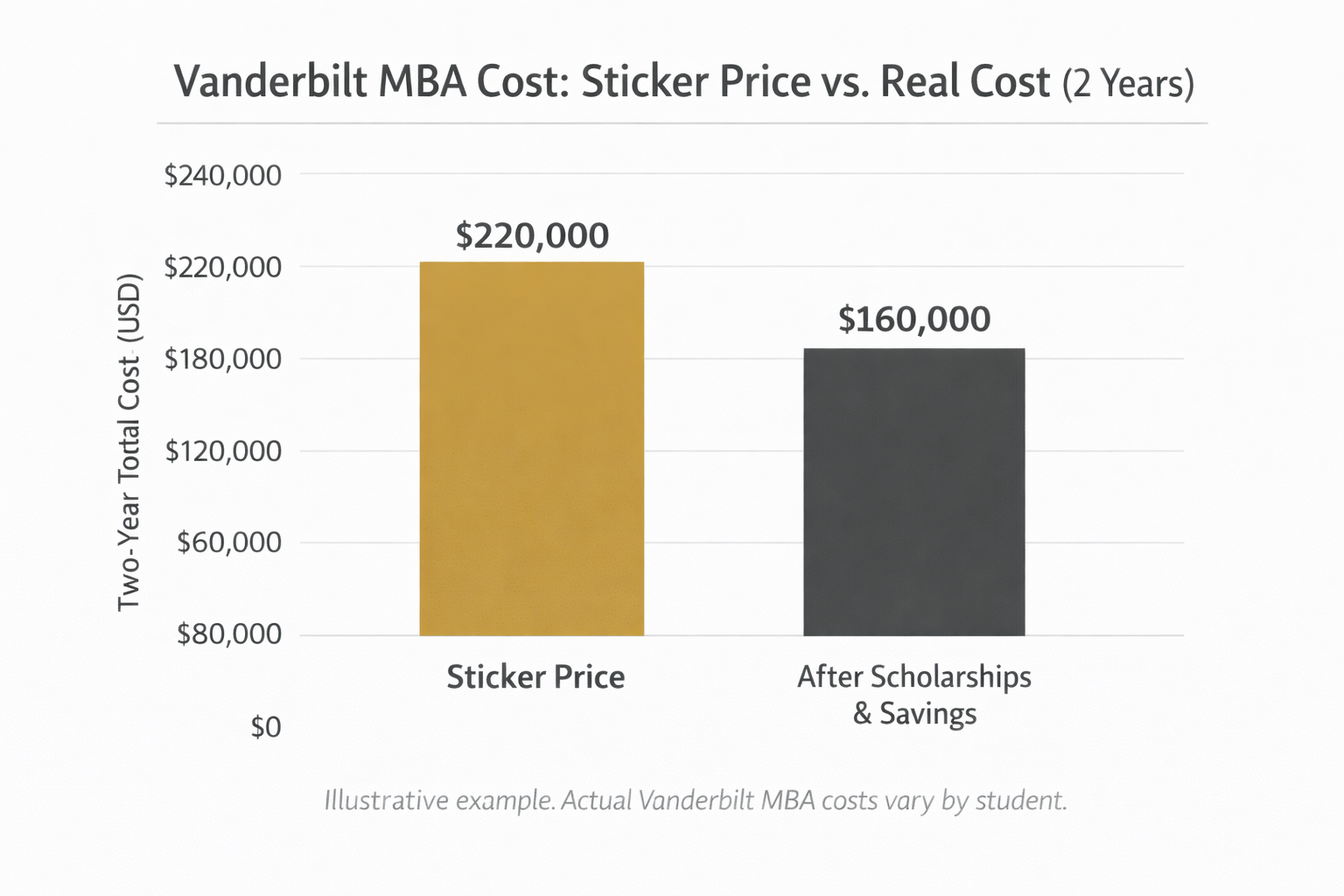
So, you’re realistically looking at a two-year investment near or above $200,000 when you factor in opportunity cost (lost salary) on top of direct expenses.
Key Insight: Always work with COA + lost income, not tuition alone. That’s the real Vanderbilt MBA cost you’re committing to.
Vanderbilt MBA Cost Breakdown: Tuition, Fees & Living in Nashville
Let’s break the Vanderbilt MBA cost into parts so you can budget more precisely.
1. Tuition & Mandatory Fees
Exact tuition changes yearly, but in recent cycles Vanderbilt Owen has:
- Annual tuition: mid‑$60,000s range
- Mandatory fees: a few thousand dollars per year (student services, activities, health fees)
Unlike some public schools, Vanderbilt is a private university, so there’s no in‑state tuition discount. Everyone pays roughly the same base rate.
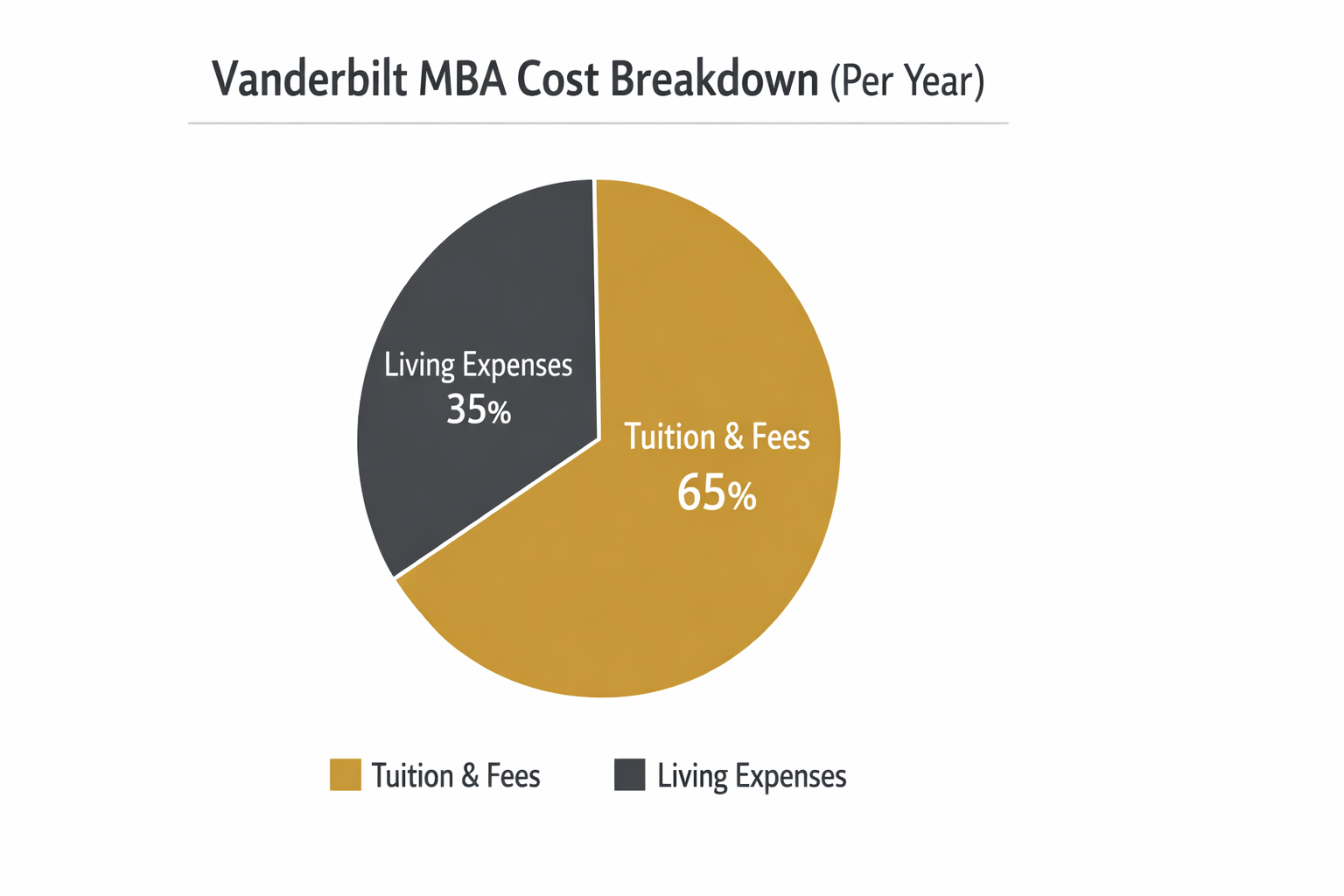
2. Cost of Living in Nashville
Nashville isn’t cheap anymore, but it’s still often more affordable than NYC, Boston, or San Francisco.
Expect rough annual estimates like:
- Rent and utilities: shared housing can keep this moderate
- Food and groceries: depends heavily on lifestyle
- Transportation: car ownership vs. rideshare/public transit
- Personal expenses: phone, subscriptions, clothing, travel
Many Vanderbilt MBA students share apartments or live slightly outside the city core to keep costs down. Compared with coastal cities, Nashville’s cost of living can lower your overall Vanderbilt MBA cost by tens of thousands over two years.
3. Hidden and Optional Costs
In addition to official COA, plan for:
- Recruiting trips and interview travel
- Student clubs and conferences (dues, travel, tickets)
- Study abroad or global immersion programs
- Laptop upgrade, software, and course materials
These can easily add $5,000–$10,000 across two years if you’re active in clubs and experiential programs.
Financial Aid and Vanderbilt MBA Scholarships
The sticker Vanderbilt MBA cost is not what most students actually pay. Scholarships and aid are a big part of the story.
Merit-Based Scholarships
Vanderbilt Owen is known for strong merit-based scholarships. Awards are typically based on:
- GMAT/GRE scores and undergraduate GPA
- Professional experience and leadership
- Diversity of background, industry, and geography
- Overall strength of your application story
Many students receive partial tuition scholarships, and a smaller group receives large or even full-tuition awards.
Pro Tip: Treat scholarship negotiation as part of your application strategy. If you receive offers from comparable schools, you can sometimes use them to request a scholarship review at Vanderbilt.
Need-Based Aid & Loans
For U.S. students, federal loans can cover:
- Remaining tuition after scholarships
- Living expenses up to the school’s COA estimate
International students typically rely on:
- Private lenders (sometimes with school partnerships)
- Home-country banks
- Personal or family funding
Employer Sponsorship & Veterans Benefits
If you’re already working for a large company, check:
- MBA sponsorship or tuition assistance policies
- Will they sponsor part-time, full-time, or executive formats only?
Veterans may be able to apply GI Bill® benefits and Yellow Ribbon support to reduce the Vanderbilt MBA cost dramatically.
Vanderbilt MBA ROI: Salaries, Payback Time & Career Upside
Cost matters, but ROI matters more. Is the Vanderbilt MBA cost justified by post-MBA outcomes?
While exact figures vary by class year and industry, recent trends from Vanderbilt Owen and comparable schools show:
- High employment rates: Many top U.S. MBA programs report 90–95% of graduates employed within three months, and Vanderbilt is in that range.
- Six-figure starting salaries: Median base salaries for U.S. MBAs are now well into six figures, with signing bonuses common in consulting, tech, and finance.
- Significant salary jumps: It’s not unusual for students coming from non-business backgrounds to double their pre-MBA salary within a few years.
Example scenario
- Pre-MBA salary: $70,000
- Post-MBA starting salary: $135,000 (base only)
- Increase: +$65,000 in the first year alone
Even if your total Vanderbilt MBA cost is ~$220,000 (tuition, living, and lost income), a salary jump of this scale can mean a payback period of 3–6 years, depending on your spending and loan strategy.
Key Insight: ROI depends heavily on industry choice. Consulting and tech tend to offer the fastest payback; non-profit and social impact roles may provide more purpose but slower financial return.
For more detailed salary benchmarks and recruiting outcomes, check:
- Vanderbilt Owen’s own MBA employment reports
- Independent profiles on sites like GMAT Club and Fortune Education
Smart Ways to Reduce Your Vanderbilt MBA Cost
You can’t change the list price, but you can change what you personally pay.
1. Optimize Your Application for Scholarships
To maximize merit aid:
- Boost your test score (GMAT/GRE) as much as possible.
- Highlight leadership and impact in your resume and essays.
- Show clear career goals and strong fit with Vanderbilt Owen’s culture.
- If admitted with a lower offer than peer schools, politely ask for a reconsideration.
2. Cut Living Expenses in Nashville
A few decisions can trim thousands off your Vanderbilt MBA cost:
- Share housing with roommates instead of living alone.
- Use public transit, biking, or car-sharing instead of owning a car.
- Set a monthly food and entertainment budget and stick to it.
3. Work Strategically During the MBA
While a full-time MBA keeps you busy, some students:
- Take on-campus research or teaching assistant roles
- Freelance or consult a few hours per week (if allowed by visa status)
- Work paid internships during summer and sometimes during the school year
Comparing Vanderbilt MBA Cost to Other Top Programs
How does Vanderbilt MBA cost stack up against other business schools?
Broadly:
- Top private MBAs (M7 and similar) often have annual tuition in the high‑$70,000s or more, with total COA well over $110,000 per year in expensive cities.
- Vanderbilt Owen’s tuition is typically somewhat lower, and Nashville’s cost of living is also generally below that of NYC, Boston, SF, or Chicago.
Over two years, that can translate into:
- Tens of thousands of dollars less in total spending
- Lower loan balances and interest costs over time
External comparisons, such as this overview of MBA cost in the USA, consistently place Vanderbilt among high-quality but relatively more affordable private programs when you consider both tuition and location.
Pro Tip: When comparing offers, create a side-by-side spreadsheet including: tuition, fees, COA, scholarship amount, and expected post‑MBA salaries by school. Don’t decide on tuition alone.
Is the Vanderbilt MBA Cost Worth It for You?
No article can tell you definitively whether the Vanderbilt MBA cost is “worth it”—because that depends on your goals, risk tolerance, and finances.
The investment may be worth it if:
- You’re pivoting into higher-paying fields (consulting, tech PM, investment banking, corporate strategy).
- You want access to a tight-knit network in the U.S. South and beyond, with small cohort culture.
- You value hands-on learning, small class sizes, and strong career coaching.
You should be more cautious if:
- You’re unsure about your post-MBA direction and may end up in lower-paying roles.
- You’d need to fund the entire Vanderbilt MBA cost with high-interest private loans.
- A large debt load would prevent other life goals (home purchase, family plans, entrepreneurship).
Ask yourself:
- “If I stay in my current path for 5–10 years, where will I be financially and professionally?”
- “With a Vanderbilt MBA, where could I realistically be in 5–10 years?”
If the second path is clearly more compelling—even after modeling the debt—then the Vanderbilt MBA cost can be a rational, strategic investment.
Conclusion
Understanding the Vanderbilt MBA cost is about much more than memorizing a tuition number. You need a clear view of total cost of attendance, living expenses in Nashville, hidden program costs, scholarship potential, and expected salary outcomes.
Next steps:
- Download or build a personal MBA cost-and-ROI calculator using realistic numbers.
- Check Vanderbilt Owen’s official tuition and financial aid pages for the latest data.
- Compare Vanderbilt’s offer with 2–3 other schools, including scholarships and expected salaries, not just sticker prices.
If you do that homework honestly, you’ll know whether the Vanderbilt MBA cost is the right move for your career and your bank account.
FAQs
Q: What is the total Vanderbilt MBA cost for two years?
A: Exact amounts change annually, but many students should plan for over $200,000 across two years when you combine tuition, fees, living expenses in Nashville, and other costs.
Q: Does Vanderbilt offer MBA scholarships that significantly reduce cost?
A: Yes. Vanderbilt Owen offers competitive merit-based scholarships, and many admitted students receive partial tuition awards.
Q: Can international students get funding to cover Vanderbilt MBA cost?
A: International students commonly use a mix of school scholarships, home-country bank loans, and U.S. private lenders (sometimes via school partnerships).
Q: How long does it take to pay back the Vanderbilt MBA cost?
A: For students entering higher-paying fields, a reasonable payback period is often 3–6 years, depending on starting salary, debt level, and lifestyle choices.